Celebrating our heritage, uniting our people through centuries of tradition
Each festival carries centuries of history, spiritual significance, and cultural identity

Today, Homowo is a harvest festival celebrated by the Ga people in Greater Accra. The festival commemorates the Ga people's survival of severe famine and honors their ancestors. It involves elaborate rituals including the washing of the chiefs' feet, traditional drumming, and the famous "Kpashru" procession.
During the festival, families prepare traditional dishes including "Tornado" (fish and palm oil stew) and "Kpekpele" (steamed corn dough). Palm wine is sprinkled on the Krofor (kings) as part of the sacred rituals.
Homowo strengthens community bonds and preserves Ga cultural heritage. It reminds the Ga people of their resilience and unity in overcoming adversity.

History: The Odwira festival dates back to the founding of the Akan Kingdom centuries ago. Originally a harvest thanksgiving ceremony, it evolved to become one of the most important Akan festivals, celebrated by the Ashanti, Akuapem, and Fante peoples. The festival marks the end of the harvest season and honors the ancestors.
Odwira is a purification and thanksgiving festival that marks the harvest season. It involves ritual cleansing, drumming, dancing, and the symbolic renewal of bonds between the living and the departed. The festival includes the sacred "Adae" ceremony where traditional rulers gather to pay homage to the ancestors.
"Akwasidae" a Sunday-basedOdwira reinforces the Akan belief in ancestral spirits and their continued involvement in the lives of their descendants. It teaches gratitude, respect for elders, and the importance of community.

History: The Aboakyir festival originated centuries ago among the Effutu people of Winneba as a ritual to prove the bravery and hunting skills of young warriors. Historically, the festival was a military exercise where young men proved their readiness to protect the community. The word "Aboakyir" means "deer hunting" in the Effutu language.
The festival features a traditional deer hunt where two Asafo companies (military groups) compete to hunt a deer first. The hunt begins at dawn with the firing of a musket. The winning team receives the prestigious "Golden Stool" honor and immense community respect.
The celebration includes elaborate drumming, dancing, and a grand procession to the chief's palace. An "Awo" (traditional priest) blesses the hunters before they set out, invoking ancestral protection for a successful hunt.
Aboakyir showcases the Effutu's rich military traditions and preserves the values of bravery, teamwork, and community service. It brings the community together in friendly competition.

History: The Damba festival commemorates the birth of the Prophet Mohammed and has been celebrated in Dagbon for over 400 years. The festival was introduced through trade routes that connected Northern Ghana with the Mali Empire, where Islam spread. It represents the harmonious blend of indigenous Dagbon traditions with Islamic practices.
The Damba is marked by magnificent drumming, traditional dancing, and spectacular horse riding displays. The festival brings together the entire Dagbon kingdom in joyous celebration. The "Naa" (King) appears in his royal regalia, surrounded by drummers and horsemen.
horses beautifully decoratedThe Damba festival represents the spiritual connection between Dagbon's traditional religion and Islam. It showcases the kingdom's Islamic heritage blended with indigenous traditions.
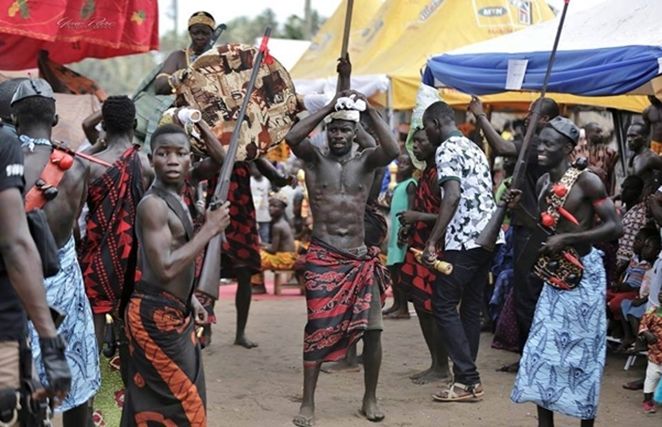
History: The Kundum festival dates back to ancient times when the Nzema and Ahanta peoples lived in the Western Region. Originating as a harvest thanksgiving ceremony, it has been celebrated for centuries to give thanks for a successful harvest and to pray for prosperity in the coming year.
Kundum is the thanksgiving harvest festival of the Nzema and Ahanta peoples in the Western Region. The celebration spans several days and includes the traditional "ndu" (palm wine) ceremony. Extended families and communities gather to celebrate together.
The celebrations begin with the "An Cle" ceremony where the chief's palace is cleansed. Traditional "Kundum" drums are played continuously throughout the night. Local dishes like "Abenkwan" (palm nut soup) and "Fufuo" (pounded yam) are prepared in abundance.
Kundum celebrates the agricultural heritage of the Nzema and Ahanta peoples. It brings communities together, strengthens family bonds, and preserves traditional food culture.

History: The Hogbetsotso festival commemorates the migration of the Ewe people from the ancient kingdom of Nnodi to their present homeland in Volta Region. The name means "migration" in Ewe, and the festival recreates the historic journey of the Ewe ancestors.
"Dzelele" dance a powerfulThe festival also features "Todzi" (ring dance), where participants hold hands in a circle and dance to traditional songs. Families prepare special dishes including "Aklovi" (fried plantain) and "Azidagbor" (spiced fish stew).
Hogbetsotso strengthens Ewe identity and unity. It reminds the Ewe people of their origins and reinforces the values of togetherness and cultural preservation.
Bringing communities together
Thanksgiving for harvest
Preserving traditions
Joyful expression